
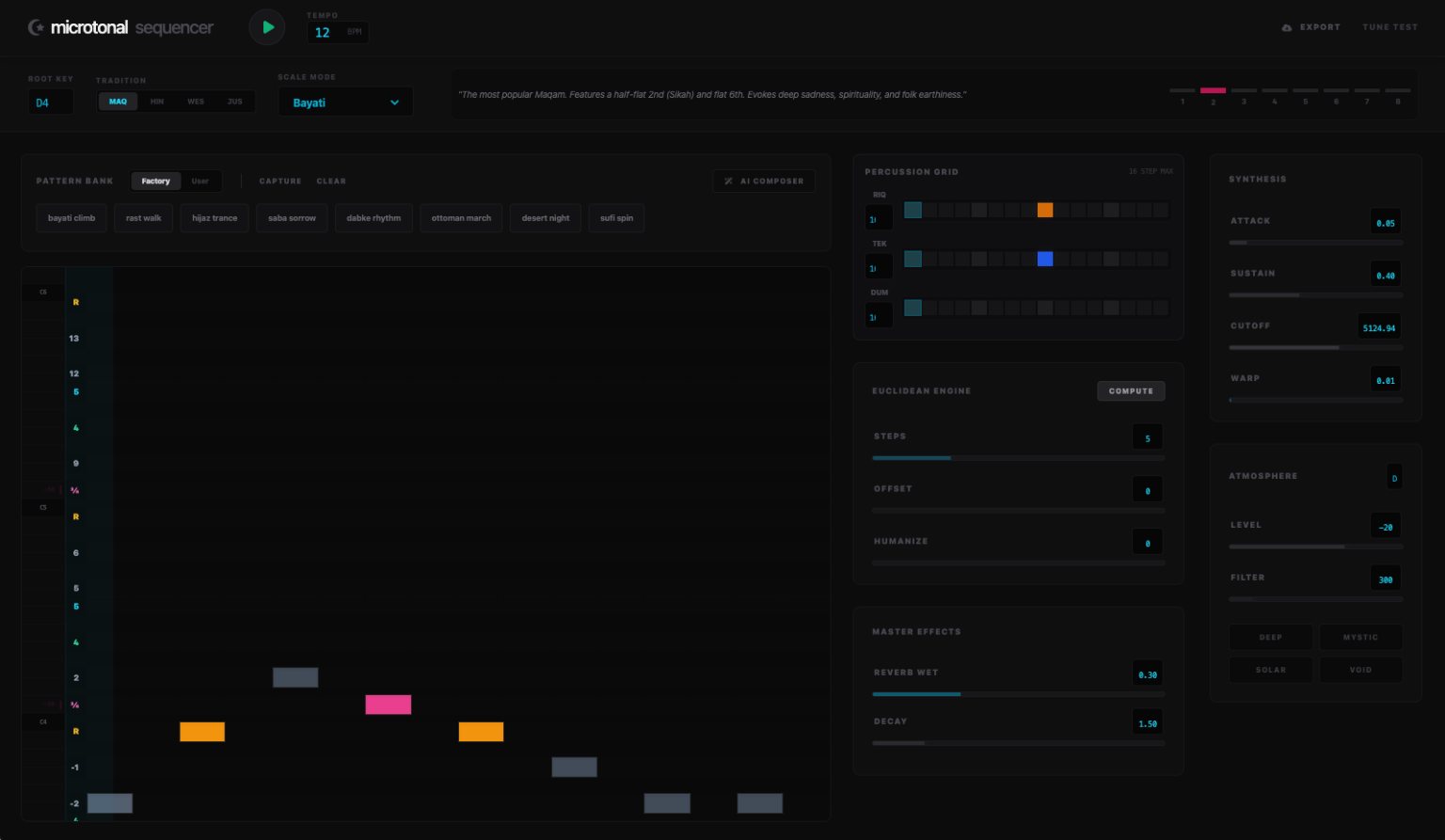
microtonal sequencer is a professional-grade microtonal sequencer designed to explore the rich melodic and rhythmic traditions of the Middle East, India, and beyond. Unlike Western sequencers limited to 12 semi-tones, this engine supports high-precision microtonality and non-equal-tempered scales.
1. Understanding Maqams (Modes)
In Arabic, Turkish, and Persian music, a Maqam is more than just a scale; it is a system of melodic progression, modulation, and emotional character.
Microtonality: The Quarter-Tone
The most distinct feature of Maqams is the use of intervals that fall between the keys of a piano.
- Sikah (Neutral Third): Found in Maqam Bayati and Rast. It is approximately halfway between a Minor 3rd and a Major 3rd.
- 24-TET: This app primarily operates on a 24-Tone Equal Temperament grid (50 cents per step), allowing for the “half-flat” (demicomma) notes essential to the Eastern sound.
Included Maqams
- Bayati: (D – E half-flat – F – G – A – Bb – C – D). Deeply emotional and folk-oriented.
- Rast: The foundation of the system. Features half-flat 3rds and 7ths. Majestic and prideful.
- Hijaz: Famous for its augmented second interval (flat 2nd to major 3rd), giving it a “mystic” desert character.
- Saba: Unique for its diminished 4th, creating a sense of painful yearning.
2. Hindustani Thaats
We have included the 10 foundation scales of North Indian classical music:
- Bhairav: The morning raga with flat 2nd and flat 6th.
- Todi: A highly complex microtonal scale featuring flat 2nd, flat 3rd, and sharp 4th.
3. Synthesis & Microtuning Logic
The Engine
The synth uses a high-precision oscillator that accepts floating-point MIDI values.
- Interval Logic: Instead of
[0, 2, 4...], we use[0, 1.5, 3.5...]. - Cent Deviations: In the sequencer grid, you will see “cents” (e.g., -50c). This indicates the distance from the nearest Western semi-tone.
Euclidean Rhythms
The percussion engine uses the Bjorklund Algorithm to distribute pulses as evenly as possible across a set number of steps. This creates the “circular” rhythmic feel found in traditional hand-drumming (Darbuka/Riq).
4. Master FX & Troubleshooting
If the sound feels “washed out,” check the Master FX panel:
- Reverb Wet: Controls the global space. Set to 0% for a dry, “in-your-face” studio sound.
- Warp/Width: Controls the chorus/vibrato. High settings create a “Ney” (flute) like instability, while low settings provide stable, digital precision.