
Overview
Drone Cycle is a high-precision generative microtonal synthesizer designed for immersive, evolving sonic landscapes. It merges ancient harmonic theory with modern algorithmic modulation, providing a platform for exploring Just Intonation, Maqam structures, and Hindustani microtonal clusters through a reactive, tactile interface.
1. Sound Synthesis & Signal Architecture
The audio engine is built on the Web Audio API, utilizing a modular signal path designed for warmth, depth, and non-linear character.
Oscillator Cluster
Each drone is comprised of three independent voices (Osc A, B, and C). These voices can be configured as Sine, Sawtooth, Square, or Triangle waves.
- Additive Depth: By stacking different waveforms across octaves, users can create complex timbres ranging from pure glass-like tones to aggressive, harmonic-rich textures.
- Local Timbre (Tone): Each voice passes through a local 12dB/octave lowpass filter before hitting the global bus. This allows for individual “shading” of voices within a single chord.
The Processing Path (Global Chain)
Once the voices are summed, they pass through a sophisticated serial processing chain:
- Spectral Filter: A global resonant lowpass filter for overall “sheen” and dark/light control.
- 3-Band EQ: Specifically tuned for drone work:
- Low Shelf (200Hz): For structural weight.
- Peaking Mid (1kHz): For harmonic definition.
- High Shelf (5kHz): For air and presence.
- Non-linear Drive: A custom
WaveShaperNodeimplementing a hyperbolic tangent-style saturation curve. This adds “grit” and “glue” by introducing subtle odd-order harmonics as the drive is increased. - Dynamics Compression: A final stage that tames peaks and brings forward the subtle “tails” of the generative modulation, ensuring a dense, consistent wall of sound.
2. The Flux Engine (Modulation)
The core innovation of Drone Cycle is its Bi-Modal Flux Engine, which automates parameter movement within user-defined boundaries.
WANDER (Brownian Motion)
In “Wander” mode, parameters move via a Random Walk algorithm.
- Logic: Every 40ms, a small random “drift” is added to the current value.
- Boundaries: If a value hits the “Min” or “Max” stops on the slider, it “bounces” back into the valid range. This creates an organic, unpredictable evolution similar to wind or flowing water.
CYCLE (Deterministic Pendulum)
In “Cycle” mode, the parameters follow a linear path at a fixed rate.
- Logic: The value increases until it hits the “Max” stop, then reverses direction until it hits the “Min” stop.
- Application: This creates rhythmic “pulsing” or “breathing” in the filter cutoff or amplitude, allowing for structured, repetitive movement.
Grid Flux
The pad grid also supports flux.
- Wander: Randomly latches and unlatches notes, creating shifting harmonic clouds.
- Cycle: Implements a “Snake” or “Pendulum” sequence across rows. Each row moves its active note from left to right, then right to left, independently, resulting in complex phase relationships between octaves.
3. Music Theory & Tuning Systems
Drone Cycle departs from standard Western tuning to offer four distinct harmonic frameworks.
Tuning Systems
The engine uses frequency ratios rather than fixed semitone steps to calculate pitch:
- 12-TET (Standard): The familiar Western Equal Temperament. Useful for compatibility with modern instruments.
- Just Intonation (Natural Harmonics): Based on whole-number ratios (e.g., 3/2 for a perfect fifth). This results in “beating-free” intervals that feel exceptionally pure and resonant.
- Maqam: Inspired by Arabic music theory, introducing slight shifts in the 2nd and 6th degrees to approximate the feel of traditional Middle Eastern scales.
- Hindustani (Vedic): Utilizes ancient Shruti ratios (e.g., 256/243 for the minor second), providing the specific “gravity” found in Indian Classical Ragas.
Diatonic Flavor (Modes)
The engine applies these tuning systems to the seven traditional Diatonic Modes:
- Ionian (Major): Bright and stable.
- Dorian: Soulful, minor-key jazz feel.
- Phrygian: Dark, tense, exotic.
- Lydian: Ethereal, “searching” (Raised 4th).
- Mixolydian: Bluesy, dominant-centered.
- Aeolian (Minor): Classic sadness/tension.
- Locrian: Diminished, unstable, haunting.
4. User Interaction
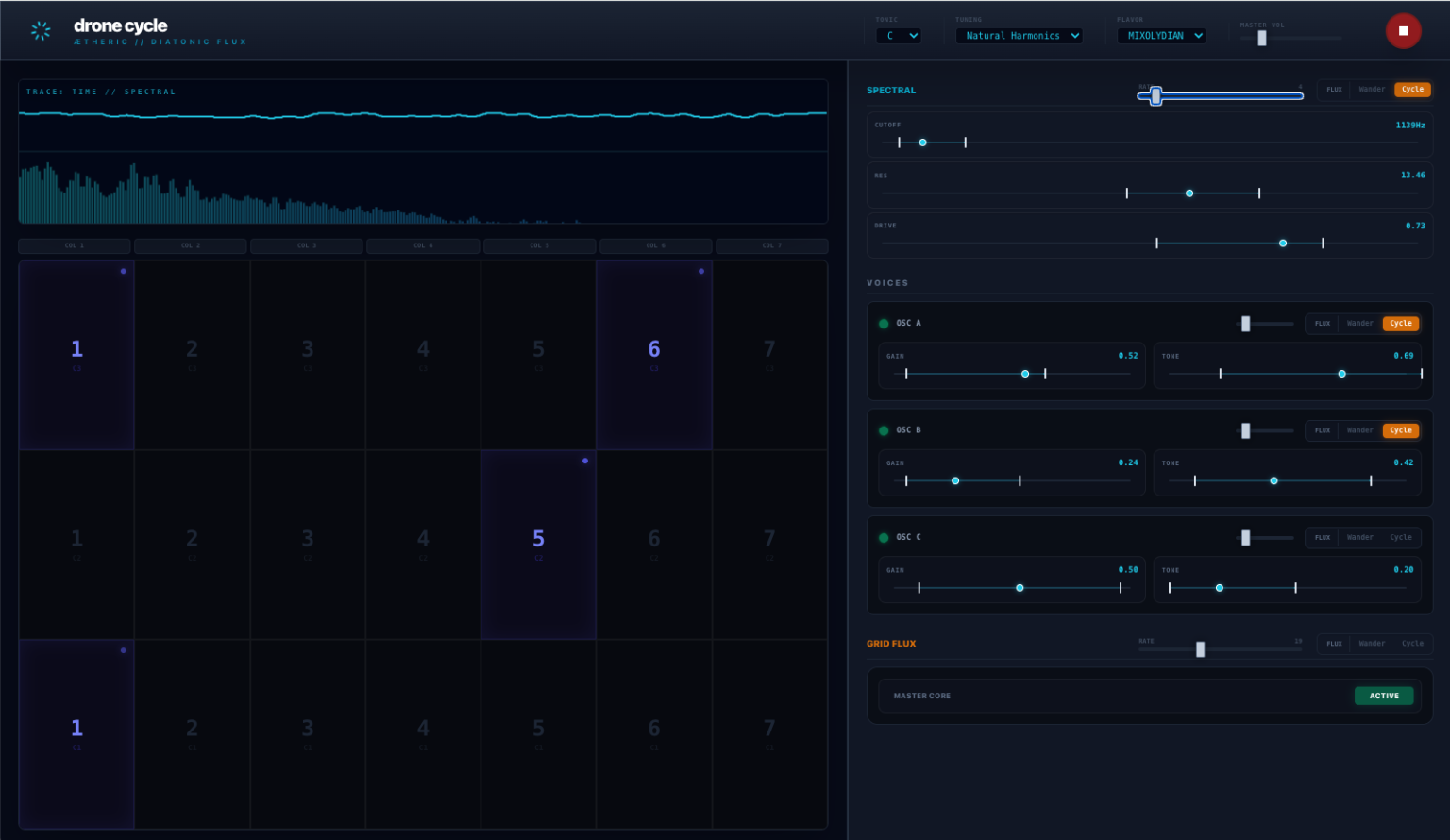
- Interactive Pad Grid: 21 notes across 3 octaves. Double-click to “latch” a note into the drone.
- Column Skipping: Toggle the “Skip” buttons at the top of the grid to disable specific scale degrees (e.g., skip the 4th and 7th to create a Pentatonic drone).
- Multi-Stop Sliders: The sliders feature three handles:
- Central Circle: Current value.
- Left/Right Bars: The Min and Max boundaries for the Flux engine.
- Visualizer: A dual-trace display showing the Time Domain (Oscilloscope) in blue and the Frequency Spectrum (Spectrograph) in the background glow, providing real-time feedback on harmonic content.
Designed for composers, meditators, and sonic explorers.