
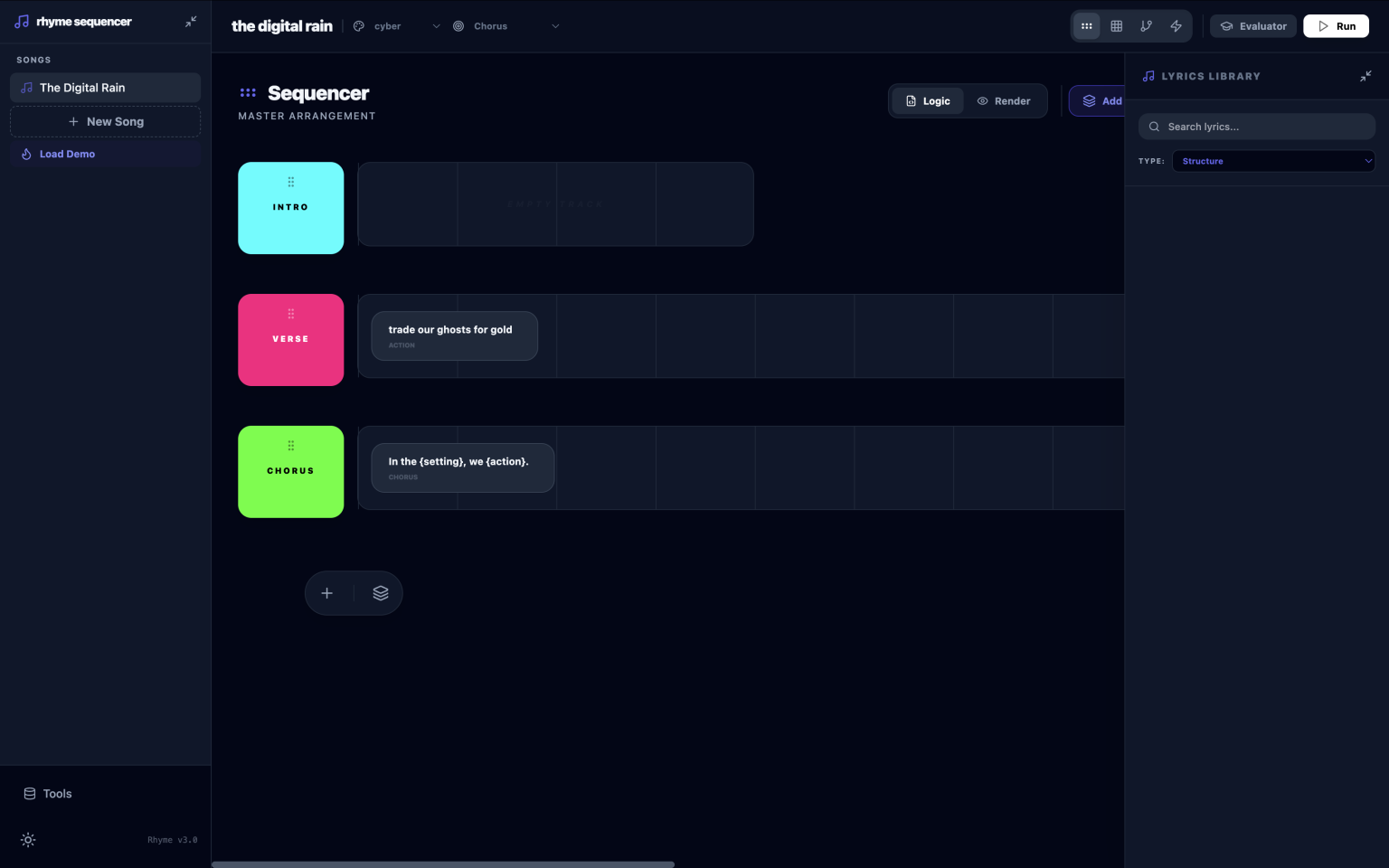
🎙️ Rhyme Sequencer: Lyric RTN Architect
Rhyme Sequencer is a visual environment for building Recursive Transition Networks (RTN) to generate complex, evolving lyrical patterns. It shifts the act of songwriting from linear word-smithing to systemic architectural design.
🧠 Conceptual Underpinnings
Recursive Transition Networks (RTNs)
An RTN is a graph-based model of a Context-Free Grammar (CFG). In a standard transition network (like a Finite State Machine), you move from state to state. In a Recursive Transition Network, a state can trigger an entirely new sub-network.
In this app:
- Nodes represent non-terminal symbols (e.g.,
{verse},{metaphor}). - Options represent production rules (e.g.,
{verse}can become “I saw the {object}”). - Recursion allows a node to eventually call itself or a chain of nodes that lead back to it, creating infinite or deeply nested variety.
Formal Systems & Generative Art
By using Rhyme Sequencer, you are defining a Formal System. You provide a finite set of symbols and rules, and the “Engine” enumerates the potential outputs. This is the heart of generative techniques: you aren’t writing a song; you are writing a probabilistic space that contains thousands of possible songs.
Relation to Linguistics
The app mirrors how natural language works (Syntactic Structures). Just as a “Sentence” is a “Noun Phrase” + a “Verb Phrase,” your “Chorus” might be an “Action” + a “Setting.” By breaking lyrics into atomic components, you can swap the “voice” or “mood” of a piece by simply changing a high-level node.
🛠️ How to Use
- Create a Node: Start by adding a node (e.g., “Main Theme”).
- Define Options: Add variations of a line. Use braces
{}to reference other nodes by their slugs. Example:The {color} sky over {city}. - Build the Hierarchy: Create the
colorandcitynodes. The app will visually link them in the Visualizer view. - The Sequencer: Drag nodes from your library into the timeline. Each “Instance” in the sequencer can be a static line or a dynamic call to a complex logic tree.
- Evaluate: Use the Evaluator to “run” your system. You can see a single output or a “Batch” enumeration of all possible combinations.
- Train: In Training mode, you “vote” on outputs. This tunes the weights of the options, teaching the system which recursive paths produce the best “vibe.”
📝 Lyrical Generator Examples
1. The Metaphor Engine
Create a node called metaphor.
- Option A:
a {object} made of {material} - Option B:
the {natural_phenomenon} of the {machine_part}
When you call {metaphor} in a verse, it might generate “a heart made of glass” or “the thunder of the piston.”
2. The Narrative Loop (Structural Recursion)
Create a node called story_beat.
- Option A:
{action}. Then {action}. {ending}. - Option B:
{action}, while {story_beat}(This is recursive!)
Caution: The engine has a depth limit to prevent infinite loops, but this allows for complex, branching narratives.
3. The “Mad-Lib” Verse
- Node
Verse:I went down to the {place} to find my {person}. - Node
place:river,neon city,shattered church. - Node
person:lost brother,silent shadow,binary ghost.